
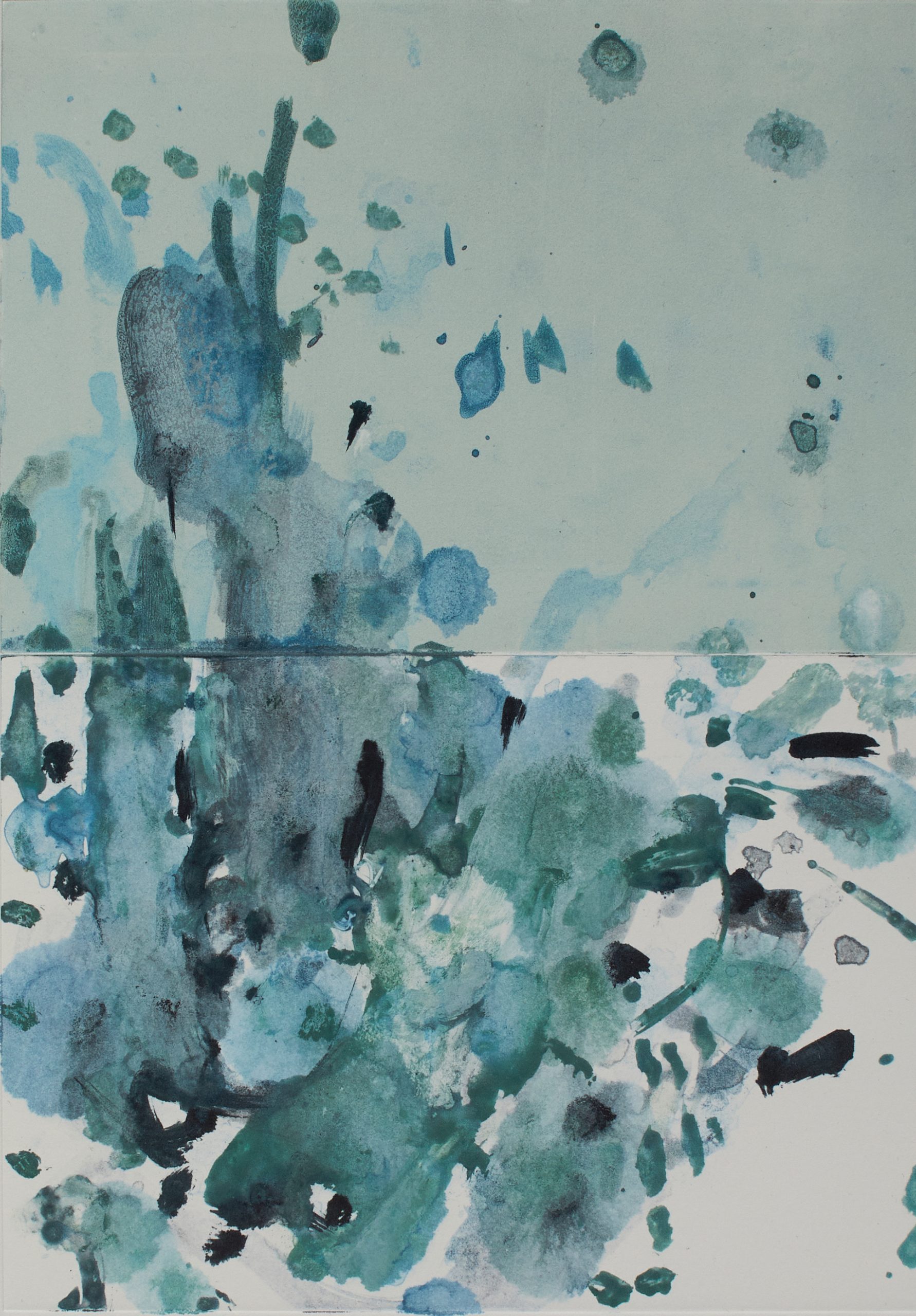
 Dark, black aquatint applied over drawing made with sugar-lift technique.
FEATURE
Aquatint
Fine resin dust is applied to the surface of the etching plate, then melted from underneath to melt and harden the dots of resin. When immersed in acid the plate ‘bites’ between the aquatint resin dots, creating a distribution of tiny holes on the plate which print as a tone.
TECHNIQUE
Aquatint
Fine resin dust is applied to the surface of the etching plate, then melted from underneath to melt and harden the dots of resin. When immersed in acid the plate ‘bites’ between the aquatint resin dots, creating a distribution of tiny holes on the plate which print as a tone.
Different tones are achieved by ‘stopping out’ areas of the plate and biting for further time. It is possible to etch a range of tones across the plate from grey to black.
Coarse aquatint uses larger resin lumps to make a more textured speckled aquatint.
Spit bite, sugar lift and white ground techniques are all used together with aquatint.
more printmaking techniques


Soft ground
Soft ground was invented in the latter half of the eighteenth century as a means of reproducing the grainy qualities of chalk work. It was first used in England by Gainsborough and artists of the Norwich School.
More Features
All features
Etching
Etching was originally invented as a method for adding decoration to armour during the Middle Ages. Artists began to use metal plates for printing in the 15th century, when Albrecht Durer made work on iron plates. Later artists such as Andrea Mantegna in Italy and Rembrandt in Holland went on to make etchings on copper.

Artist talk: Michelle Avison
From her inspirations to struggling to find a place to draw, Michelle takes us through a chronological history of her work, and how she learned to embrace the practice of looking in this video presentation.

“I would quite like a bit of a shout now.”
Artist Sarah Praill discusses the ideas and archeology behind her exhibition “To carry a feeling” at HAUSPRINT.